When you have Parkinson’s, sometimes when you’ve got to go, you’ve got to go!
The Gringotts Getaway
A few weeks ago I found myself ‘running’ away from a celebration organised by one of my best friends. I’d been struggling for a few weeks to get my meds working consistently and just when I really needed them during the event, they’d worn off. I was starting to feel really stiff and uncomfortable, my confidence levels plummeted and I became very self-conscious. I shuffled unsteadily to the restroom to gather my thoughts away from the crowds, only to find myself pondering an age old dilemma, ‘should I sit or stand?’ Sitting would mean frustratingly fiddling with multiple fastenings and I just did not have the patience. Standing, on the other hand, involves other risks but I impressed myself with my precision. Taking this as a divine omen to leave, I asked my wife who had ridden ‘shotgun’ to the loo with me, if she would quietly return to our seats, grab our things, and join me in a silent exit.
Unfortunately, our hosts came over to be social just as she reached our table. Cracking instantly under the pressure of their intense information gathering technique, she was compelled to confess that I was in the process of an escape attempt when they asked “where’s Mark?” This resulted in the entire table of guests trooping out to the foyer, where they found me trying to look nonchalant, hunched over my trekking poles, depositing the sand from the tunnel I had been digging with a spoon from the dessert trolley, much like ‘Schuey McFee’ in The Great Escape (NB: I like to think the trekking poles give me more street cred than walking sticks—more ‘Ranulph Fiennes’, less ‘Marty Crane’).
At this point I was so preoccupied computing my flight path across the polished marble foyer floor toward the sliding doors and freedom, that it was too late, I’d been surrounded. My table mates were animatedly arranging themselves “naturally” around me for a photo before I could make my silent exit. It reminded me of a family trip to Harry Potter World where we’d gathered around the waxwork banker in Gringotts—only this time, I was the miserable and unfriendly character in the centre.
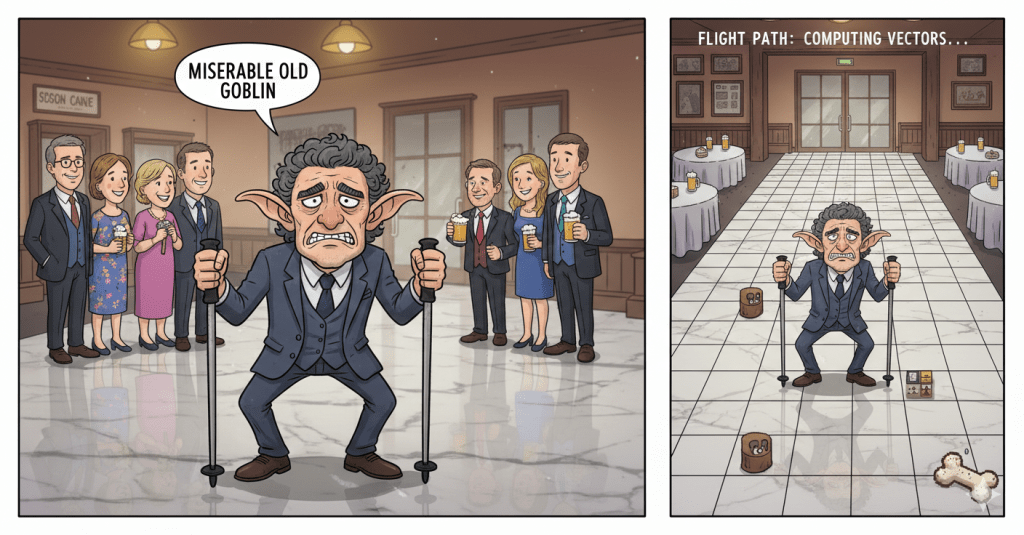
When our photographer suggested we all cross to the other side of the room for better light, my friends, noticing the black clouds gathering above my head, shouted ‘NO’ in unison. We took the picture, I clattered across the marble floor like a giant spider on roller skates, the doors automatically opening to receive me—dropping the mic as I exited the building.
Once in the car, the adrenaline faded and the guilt set in. I felt like a misery. I’d treated my friends rudely by rushing off without so much as a ‘see you later.’ Disappointed in myself, I realised I needed to understand why I was so desperate to leave.
Self Analysis: Fuss and Wet Noses
While I am coming to terms with and accept my diagnosis, coming to terms with my “New Normal,” will always be an ongoing process. When I was younger I was very self conscious and lacked self-confidence in large social gatherings, but I eventually grew out of it. One of the benefits of having Parkinson’s is time travel. It now transports me back to those days and feelings, with a whole new set of parameters. So, I shouldn’t be too hard on myself when I find I am once again struggling with my self-consciousness, especially when I’m around friends who knew me long before PD. For people with Parkinson’s, it’s the gift that keeps on giving; just as we get used to one version of ourselves, old Parky extends an existing symptom or adds another to the portfolio, surprising us with a “New, New Normal” we need to get used to every time we put ourselves out there at a social event.
Currently, if I manage to hurdle the initial anxiety of appearing “Parky” in public, the urge to flee hits the moment the meds wear off. While my brain has enough dopamine, I’m fine—I might even look good (nothing new there). But as the reservoir drops, the escape committee starts a meeting in ‘Hut 41’ and planning begins. This is located just behind the memory of the taste of my grand mother’s wedding cake she served up one Saturday tea-time, having re-discovered it 30 years later at the bottom of her wardrobe. At this point, I feel the shadow of old Parky creeping up. It starts with sciatica—a toothache that connects my left hip to my ankle as the muscles tighten. My feet get heavier, my legs disconnect from my brain, and the anxiety spikes: Will my legs lift me out of this seat, or am I heading for a face-plant in the chocolate fountain?
My onboard navigation system starts computing vectors: the number of tables between me and the exit, the entropy of the crowd, and the open spaces where I’ll be on display for all to see. I am in game of Frogger, trying to hop from one safe spot to the next before the “fuss” starts– the goodbyes, the photos, the “we must do this again” diary bookings… all while I am standing there feeling painfully stiff, hunched over, and desperate for the anonymity of the car and a seat.
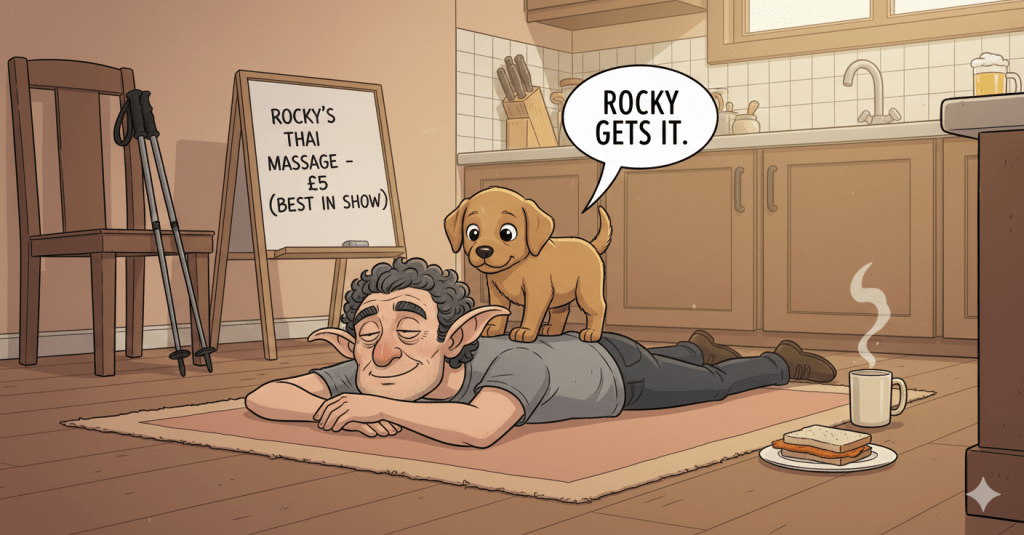
Underneath my rigid Gringott’s managerial like exterior, there is a lot going on. My friends and loved ones say they “still see me as me,” but the issue is that I don’t see me as me when I feel like this. I could just grin and bear it. Or, I can hope that my friends understand that I don’t want to be rude—I’m just in a desperate need to retreat to my kitchen floor, lie face down, and let the dog stand on my back, performing his version of a Thai massage. Rocky gets it. When I look into his eyes, I know he understands the pain and with one wet nose in my ear, he makes everything better.
If You Love Someone Let Them Flee
So, I may be exaggerating in my narrative somewhat for the purpose of your entertainment, but the next time you see me shuffling for the door without a word, please don’t be offended. And if you aren’t able to put a wet nose in my ear, just be a good friend and forgive the rudeness. One day soon, I’ll get over myself and join you for the faff.

 Balls to Parkinson’s