As a boy, I used to watch a show on the telly on a Sunday afternoon called Weekend World. It was an hour-long current affairs programme presented by the ex-MP Brian Walden. My recollection of Brian was that he never seemed a particularly cheery chappie; he had a distinctive West Bromwich accent and spoke with immense gravitas. His tone of voice always seemed to convey a weary resignation to the fact that the political issue of the day would not end well for the general public.
The show’s content was often dominated by discussions of the latest developments in the Cold War and the arms race. It was peppered by Dad’s Army style animated graphics showing the number of tanks, soldiers, and intercontinental ballistic missiles Russia, the UK, Europe, and the US had pointing at each other. Topics often centred around the likelihood and outcome of a nuclear war and who or what, if anything, would be left. In the words of Private Frazer, we were “all doomed.”
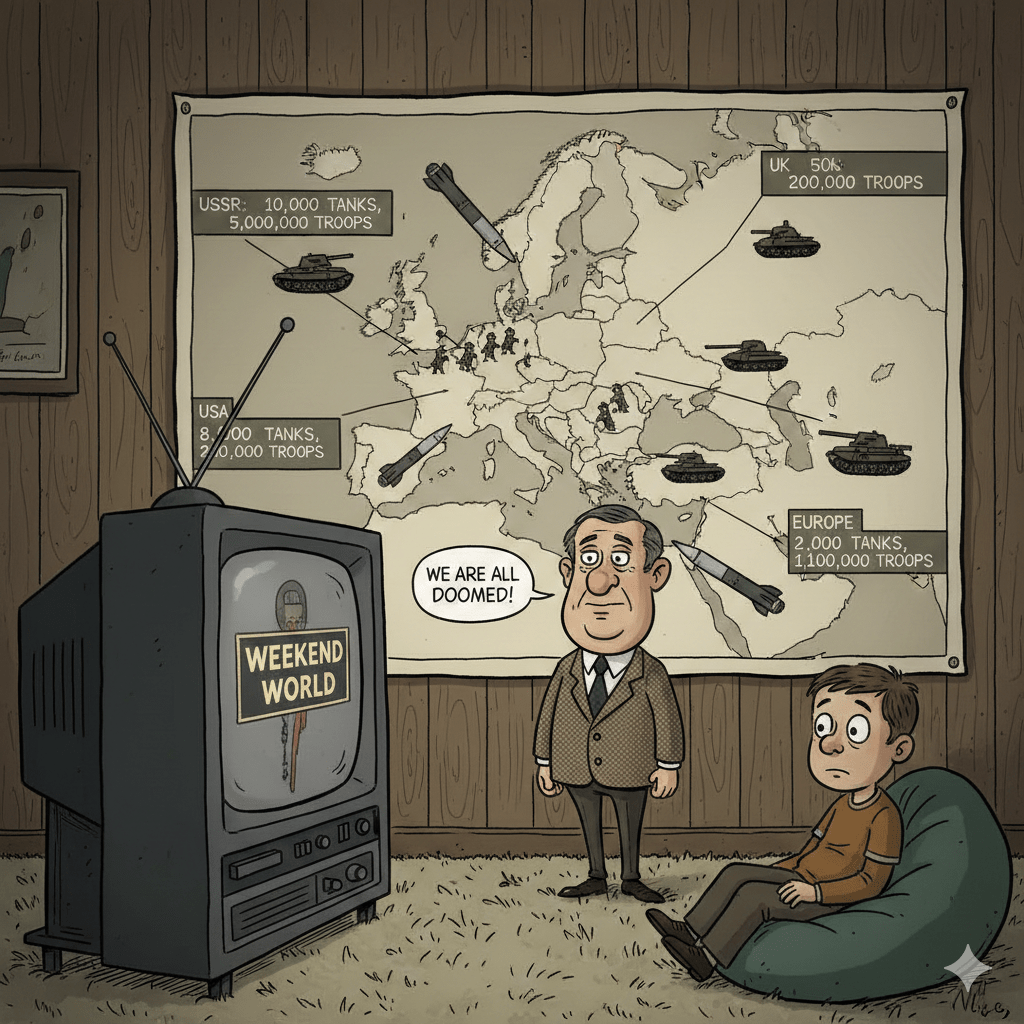
At that time in the U.K., there were only two other TV channels to choose from, so it was either ITV with Brian and nuclear Armageddon, BBC2 and Church on Sunday, or BBC1 and Grandstand with the latest horse racing from Chepstow. So, for a boy of 11 or 12 needing to fuel a fledgling addiction to the goggle box, Brian’s authoritative and hypothetical examination would have me hooked while I waited for The A-Team to save the day at 1 o’clock.
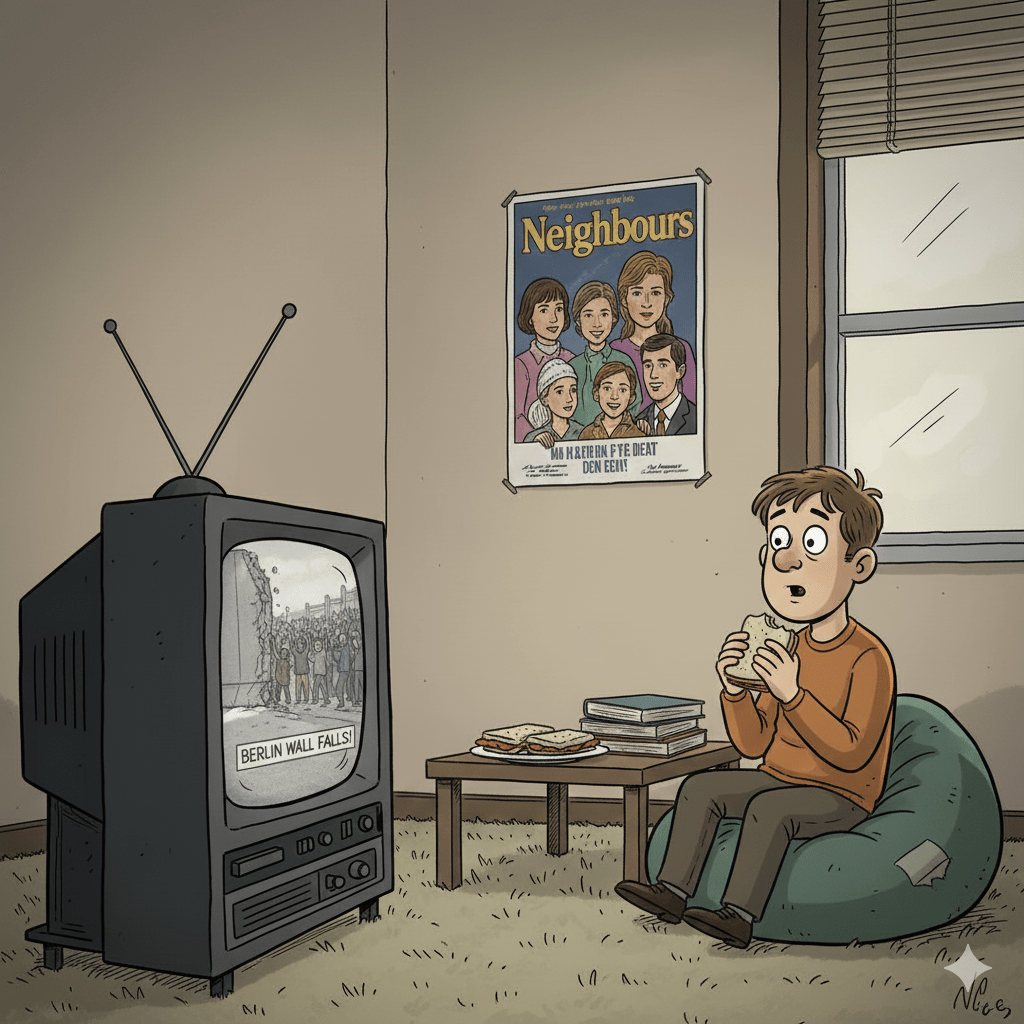
I remember watching with interest and a certain amount of trepidation as I contemplated the world blowing itself up and being left in a post-apocalyptic wasteland where only a few had survived. Living on the Isle of Wight, I imagined this to be something like Sandown seafront in the off-season. Luckily, we had Reagan and Gorbachev, who surprisingly seemed to bring everyone to their senses. To cut a long blog short, by the time I was at university regularly watching the lunchtime news in the student lounge—while eating fish finger sandwiches and waiting to see if Kylie and Jason would finally get together in Neighbours—international relations had thawed so much that walls and curtains were literally being pulled down between the East and West. We were saved from the threat of certain extinction.
This Christmas, looking back over the year 2025, I have to say that some of those old fears from my childhood are creeping unnervingly back from the darker recesses of my mind. In some ways, they seem worse now; I have a family of my own to protect, including a son who is a similar age to that kid who would end up watching Weekend World on a Sunday afternoon.
Most people I meet nowadays are blissfully unconcerned about the current poor state of US, European, and Russian relations. The subject doesn’t seem to be high on the population’s radar. I often listen to the BBC’s Ukrainecast in bed, dozing off to the relaxed tone of Victoria Derbyshire. In this week’s episode, they opened with an apology: the production team will now only be working on the show part-time, and episodes will be published intermittently when something ‘major’ happens, rather than as a regular weekly show. I assume this is due to the commercial pressures of a dwindling audience. Let’s face it, the war in Ukraine has been going on for so long that the audience has moved on, diverted by more important things—like whether the ‘big dog theory’ was correct or how Joe Mahler failed to win the latest series of Strictly Celebrity Traitors. It’s as if we think the Ukrainians are only fighting for their way of life three days a week, and Russia only invades on the weekend.
Back in the 80s, we could be confident that the ‘Special Relationship’ meant an unwavering political and military commitment to support us in the event of aggression from the East. I would never have predicted the relationship with our transatlantic “big bro” would become as uncertain as it is now. I’d watched so many movies growing up where the cavalry turned up just at the right moment to save the day. Whether it was Robert Redford leading an allied amphibious assault in A Bridge Too Far or Bill Pullman’s president rallying the world’s military in Independence Day, I was fully confident that the Western world could unite to repel any global threat. But now, with the ‘America First’ mantra emboldening superpowers elsewhere, I am not so sure.
I can’t help thinking what might happen if this escalation continues. Will there be a full-scale resumption of the arms race? How would we survive if a superpower disrupted our access to the internet and brought down the critical systems that enable our financial markets and essential utilities?
I guess we had a taste of what it might be like during the pandemic. With everyone housebound and reliant on the web for everything, panic buying emptied supermarket shelves of toilet roll, and you couldn’t get an Ocado delivery slot without virtually queuing for three hours. It was tough trying to educate the kids at home, but thankfully we had unlimited access to digital content and multiple devices we could sit them in front of while we tried to carry on with our working lives.
The pandemic and lockdown now seem like a distant memory, but we managed to get through it. Hopefully, we’ll also get through this new period of global uncertainty and the jostling for positions at the superpower head table. So, for the time being, I’ll join the rest of the folks ignoring the potential for disaster. I’ll do what I did when I was a boy and Weekend World got too depressing: I’ll switch channels—as long as no one switches off the internet.
I’ve spent the last few weeks wondering if I’m the only person currently experiencing 1980’s Cold War deja-vu. Is the current geopolitical climate on your radar, or are you firmly in the ‘ignore it until the internet goes off’ camp? Drop a comment and let me know how your thoughts.”

 Balls to Parkinson’s